Key takeaways
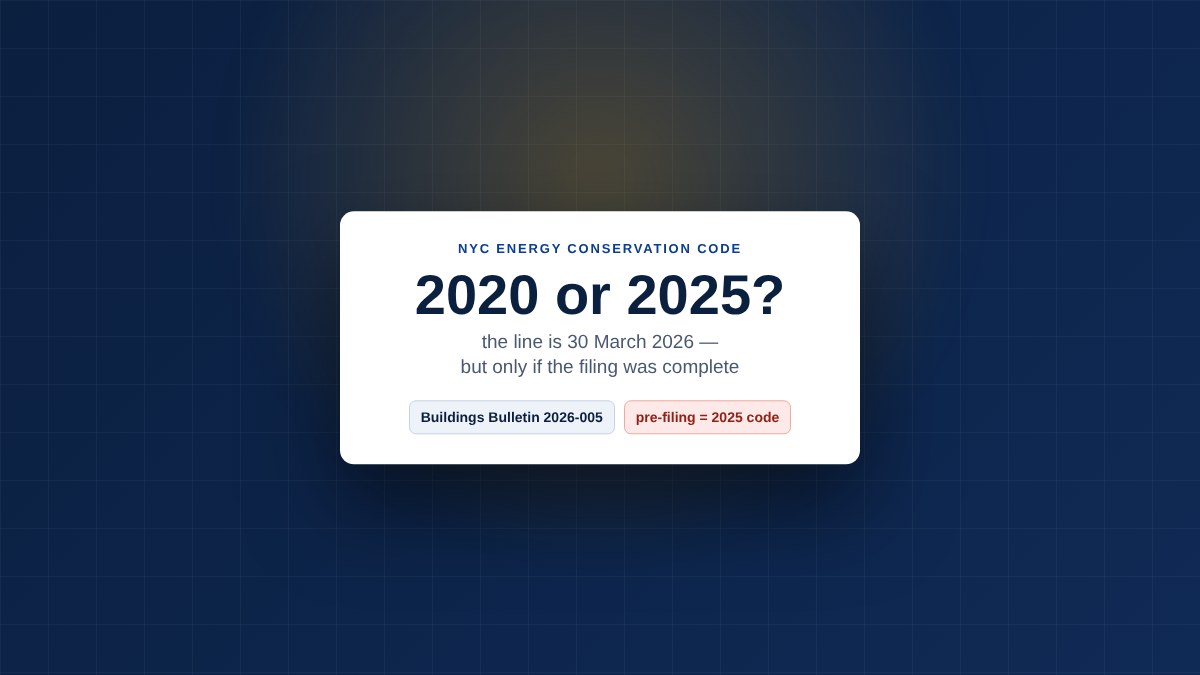
- The dividing line is March 30, 2026. Applications for construction document approval filed on or after that date must comply with the 2025 NYCECC or 2025 NYC ASHRAE 90.1; those filed before it stay under the 2020 code.
- "Filed" is a demanding word here. The application counts only if the documents are complete, it includes a complete energy analysis, and it is diligently pursued to completion.
- A job filed before the date with an incomplete energy analysis, or sitting in pre-filing status, is treated as incomplete — and falls under the 2025 code.
- Moving from a prescriptive compliance path to a modeling path after March 30 also moves the job to the 2025 code.
In this article
Every code transition produces the same argument: my job was filed before the change, so the old code applies. The Department answered it in advance, and the answer is narrower than most applicants assume.
What the bulletin says
The document is Buildings Bulletin 2026-005, issued February 17, 2026 by Deputy Commissioner for Sustainability Laura Popa, and it supersedes BB 2020-002: bb_2026-005.pdf.
The Department enforced the 2020 NYCECC until March 30, 2026, the anticipated enforcement date of the 2025 code. Applications for construction document approval filed on or after that date must comply with the 2025 code — in the bulletin's words, "the application must comply with the 2025 NYCECC or 2025 NYC ASHRAE 90.1."
What counts as filed
This is the part that decides most arguments. An application is treated as filed only where three things are true together: the construction documents are complete, the submission includes a complete energy analysis, and the application is diligently pursued to completion.
Consequently, a job that went in before March 30 with a thin or missing energy analysis does not hold its place. The bulletin states that jobs filed before the date "with an incomplete energy analysis or with a pre-filing or incomplete status" are treated as incomplete and must comply with the 2025 code.
A complete energy submission filed before the date does stay under the 2020 code. For jobs in the legacy system, the bulletin names the status combination that qualifies: job status code D with online code A or P before March 30.
Amendments, and the compliance path trap
Amendments after approval split in two. An amendment that does not make a material change to compliance may use the 2020 code, or the code in force when the project was filed. An amendment that does make a material compliance change must use the 2025 code.
Subsequent filings made after March 30 to complete an application follow the code version of the original application — again, unless they involve a material compliance change.
And then the trap. A project filed before March 30 that switches from a prescriptive path — tabular analysis, ResCheck or ComCheck — to a modeling path — ERI, energy cost budget, or Appendix G — on or after that date must comply with the 2025 code.
That matters because switching to modeling is exactly what teams do when the prescriptive route stops working. The switch is usually presented as a technical convenience. Under this bulletin it is a change of code edition.
How to use this
- Find the filing date and the state of the energy analysis for each live job. The date alone does not answer the question.
- Flag anything that sat in pre-filing before March 30. Those are on the 2025 code whatever the date says.
- Before switching to a modeling path, check what it does to the applicable code edition. Decide with that in front of you.
- Treat amendments as a code question, not only a design question: is this a material compliance change?
- Keep the energy analysis with the filing, complete, from the start. It is what makes the filing a filing.
On the existing-buildings side of the same subject, see the 2026 covered buildings list for Local Law 97 and the reporting deadlines for the year.
Frequently asked questions
We filed in February but the energy analysis went in later. Which code?
The bulletin treats a filing with an incomplete energy analysis as incomplete, which puts it under the 2025 code.
Does a small amendment move us to the 2025 code?
Only if it makes a material change to compliance. An amendment without one may use the 2020 code or the code in effect when the project was filed.
We want to move from ComCheck to energy modeling. Any downside?
Beyond the modeling work itself, the switch after March 30 moves the project to the 2025 code, even where the job was filed before that date.
Is March 30, 2026 fixed?
The bulletin describes it as the anticipated enforcement date and says any change would be announced by service update.
Where can I read the bulletin?
It is on the Department's buildings bulletins page, and the link is in the first section of this article.
Conclusion
The transition rule is not "when did you file" but "what did you file, and have you kept moving." A complete application with a complete energy analysis holds the 2020 code; a placeholder does not. And the most common mid-project decision — switching to modeling when the prescriptive route fails — carries the code edition with it.

Written by the engineers and laboratory technicians of Metric Consulting and Inspection, a Class 1 special inspection agency with a DOB-licensed concrete testing laboratory in Hicksville, New York, serving NYC construction since 2003.