Key takeaways
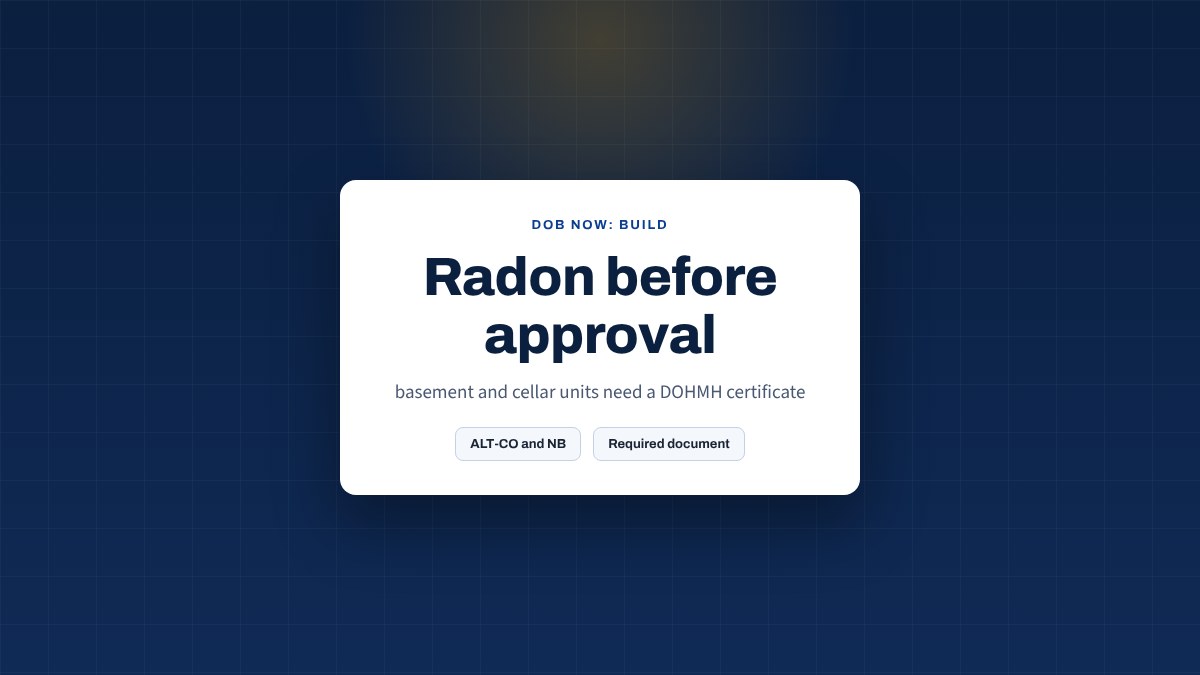
- Since August 17, 2026, applicants for Alteration-CO (ALT-CO) and New Building (NB) filings that include an ancillary dwelling unit in the basement or cellar must submit an approved DOHMH Radon and Vapor Level Certificate in DOB NOW: Build.
- The certificate comes from the Department of Health and Mental Hygiene, not from Buildings. It has to be approved before it is uploaded.
- It is a required document, which means the filing does not move until it is there.
- The basement unit is usually the whole reason for the job. If the certificate is late, the job is late.
In this article
The phrase "required document" does a lot of quiet work in a DOB NOW filing. It means the application sits where it is. This one is worse than most, because the document is issued by another agency.
What is required
The notice is dated July 31, 2026 and took effect on August 17: DOHMH Radon and Vapor Level Certificate for Ancillary Dwelling Units Submitted in DOB NOW: Build. The wording is direct. Beginning August 17, 2026, applicants for Alteration-CO and New Building job filings that include an ancillary dwelling unit in the basement or cellar are required to submit an approved DOHMH Radon and Vapor Level Certificate in DOB NOW: Build.
Three conditions have to line up for it to apply:
| Condition | Detail |
|---|---|
| Job type | Alteration-CO or New Building |
| The unit | An ancillary dwelling unit |
| Where | In the basement or the cellar |
A basement unit on any other job type is outside this requirement. An ancillary unit above grade is outside it. The requirement is aimed at exactly the case where people will be living below ground.
Why radon, and why the health department
Radon is a soil gas. It enters a building from the ground beneath it, which is why a unit in a cellar is treated differently from the same unit on the second floor. Vapor intrusion works the same way: what is in the soil finds its way into the lowest enclosed space.
Because it is a health matter rather than a structural one, the certificate is issued by DOHMH. Buildings only checks that an approved one is attached. That distinction matters for the schedule: no amount of chasing the Buildings filing moves a document that another agency has not yet issued.
The part that costs time
Testing a space for radon means measuring it, which means the space has to exist in a testable state and the measurement has to run for its own period. Then the result goes to DOHMH, and the certificate is issued or it is not.
None of that is on the construction schedule, and none of it can be compressed by filing earlier at Buildings. The only lever is starting sooner.
This is the same lesson as the sequencing change that made foundation and earthwork permits wait on the main job: when an approval depends on something outside your control, the schedule has to carry it as a real duration, not as a formality at the end of a line.
What to do
- Decide early whether the unit is in the basement or the cellar. The answer determines whether this applies at all, and it is a code question, not a marketing one.
- Start the radon work as its own task, with a named owner and a duration, at the beginning of the job rather than at the filing.
- Budget for the possibility of a result that needs mitigation. A certificate that cannot be issued as things stand is not a paperwork problem.
- Keep the approved certificate with the filing set, so that the upload is a copy-and-attach rather than a search.
- Watch the related rules. The Department has proposed amending the rules on ancillary dwelling unit entrance identification, so this is an area still being written.
The inspection scope on these jobs is unaffected. Below-grade work still brings the usual soils and concrete categories with it — the same ones described in soil compaction testing on NYC job sites — and those run on the construction schedule once the approval exists.
Frequently asked questions
Does this apply to every basement apartment?
No. It applies to Alteration-CO and New Building filings that include an ancillary dwelling unit in the basement or cellar.
Who issues the certificate?
The Department of Health and Mental Hygiene. Buildings requires that an approved one be uploaded in DOB NOW: Build.
Can we file first and add the certificate later?
It is a required document prior to approval. The filing does not progress without it.
What if the test shows a problem?
Then the matter is a health one before it is a filing one, and it has to be resolved before an approved certificate exists.
Where can I read the notice?
On the Department's service updates page, and the link is in the first section of this article. It took effect on August 17, 2026.
Conclusion
Basement units are the point of many of these jobs, and this certificate sits directly in front of the approval that lets them happen. It is not difficult and it is not expensive. It is simply issued by somebody else, which makes starting early the only thing that helps.
Written by the engineers and laboratory technicians of Metric Consulting and Inspection, a Class 1 special inspection agency with a DOB-licensed concrete testing laboratory in Hicksville, New York, serving NYC construction since 2003.