Key takeaways
- Cold weather concreting applies when the air temperature has fallen to, or is expected to fall below, 40 °F during the protection period — in New York, roughly November through March.
- Fresh concrete must be delivered at a minimum temperature (usually 55 °F for thin sections, 50 °F for thicker ones) and kept from freezing until it reaches about 500 psi — typically the first 24 to 48 hours.
- The special inspector records air and concrete temperatures at delivery and during protection, the protection method, and when it was removed. Those records are what the engineer relies on when a winter break comes in low.
- Most winter problems are not the mix. They are blankets removed too early, cylinders left outside, and nobody measuring the temperature.
In this article
New York pours concrete all winter. The code allows it, the suppliers heat the mix, and most cold weather pours are uneventful — provided someone is watching the thermometer. This article covers what the code requires, what the inspector does, and where winter pours go wrong.
When the rules apply
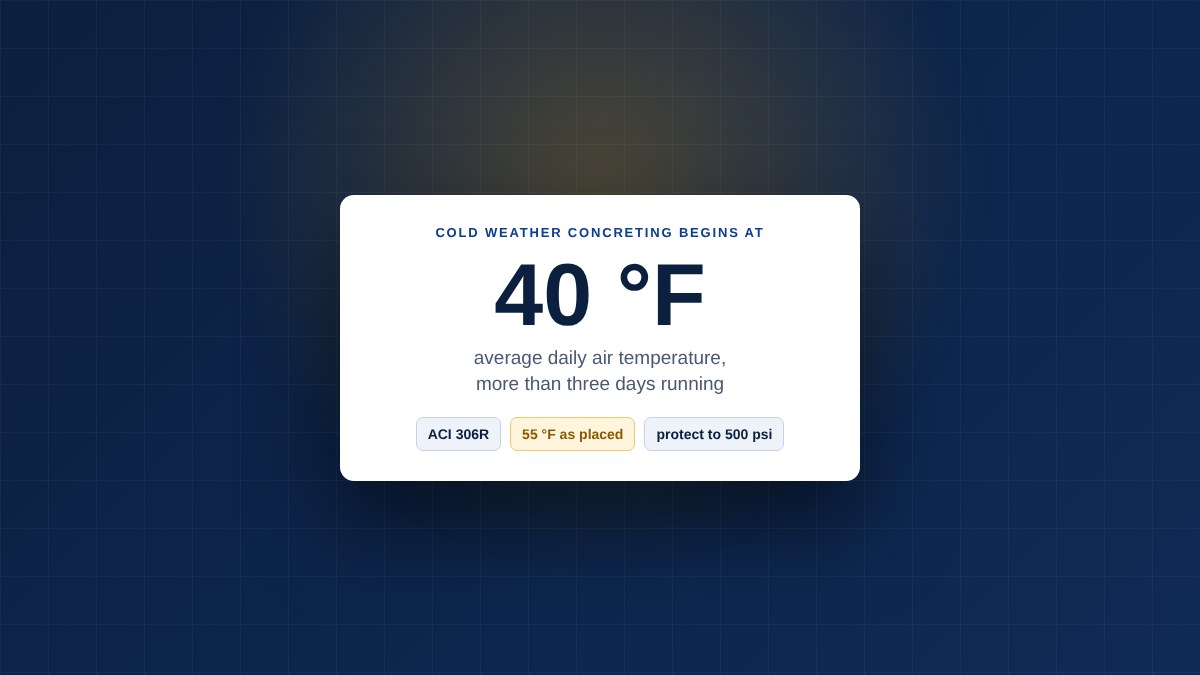
ACI 306R (Guide to Cold Weather Concreting), referenced by ACI 318 §26.5.4 and so by the NYC Building Code, defines cold weather as a period when the average daily air temperature is below 40 °F for more than three successive days, and the air temperature is not above 50 °F for more than half of any 24-hour period. In practice, the special inspection agency treats any pour where the temperature during the protection period may fall below 40 °F as a cold weather pour.
For New York City and Long Island that means: from about mid-November to mid-March, every pour; in late October and early April, check the forecast for the 48 hours after the pour, not just the morning of it.
The temperature limits
Concrete at delivery and placement (ACI 306R, Table 5.1, minimum temperature as placed):
| Section size (least dimension) | Minimum concrete temperature |
|---|---|
| Less than 12 in. | 55 °F |
| 12 to 36 in. | 50 °F |
| 36 to 72 in. | 45 °F |
| Over 72 in. | 40 °F |
The supplier reaches these by heating the mixing water and sometimes the aggregate. Concrete should also not be delivered too hot — above about 70–80 °F for cold weather mixes — because rapid temperature loss afterwards causes cracking.
Air temperature during protection: the concrete must be kept above the minimum placement temperature (and must never freeze) until it has gained enough strength to resist a freezing cycle — about 500 psi. For most mixes that is 24 to 48 hours with the temperature maintained; longer for slow-gaining mixes or very cold conditions. The engineer may require the concrete to be kept warm longer to reach a specified strength before loading or stripping forms.
Subgrade and forms: concrete must not be placed on frozen ground, ice or snow, or against frozen forms or reinforcement. The inspector checks this before the pour, not during it.
Protection methods
- Insulated blankets on slabs and walls — the most common; effective down to about 20 °F for 24–48 hours if they are in contact with the surface and held down at the edges.
- Enclosures with heaters for columns, walls and decks in extended cold; vented, because unvented combustion heaters cause carbonation of the fresh surface (dusting) and are a carbon monoxide hazard.
- Heated forms for thin elements.
- Mix adjustments: accelerating admixtures (non-chloride in reinforced concrete), higher cement content, or Type III cement, so the concrete reaches 500 psi sooner. The engineer approves changes to the mix design (TR3).
What the special inspector records
On a cold weather pour the inspection report includes, in addition to the usual data:
- Air temperature at the start and end of placement, and the forecast low.
- Concrete temperature at delivery for each sampled truck (ASTM C1064), and whether it met the minimum for the section.
- Condition of the subgrade, forms and reinforcement — not frozen, free of ice.
- The protection method in place at the end of the pour, and who is responsible for monitoring it.
- Where the cylinders were kept for initial curing and at what temperature.
- On follow-up visits, the temperature under the protection and when the protection was removed.
If the agency installs maximum–minimum thermometers or data loggers under the blankets, their readings go in the file. These records are what the engineer uses if a 28-day result comes in low: a pour that was protected and documented is accepted; a pour where nobody can say what the temperature was on the second night is a core sample waiting to happen.
The cylinders in winter
Winter produces more low 28-day results than any other season, and most of them are not the concrete. They are the cylinders: cast on site, left in a pickup bed or a cold trailer overnight, and frozen at a few hours old. ASTM C31 requires initial curing at 60–80 °F; a cylinder that freezes on night one may lose a third of its strength and never recover it.
The fix is simple: an insulated cure box with a heat source on site, cylinders moved into it immediately after casting, and a laboratory pickup within 24–48 hours. Metric's technicians check the box temperature at pickup and record it. If the structure was protected and the cylinders were not, the held cylinder and the field data usually show it, and the engineer can judge the concrete on the structure, not the specimen.
Where winter pours go wrong
- Blankets off too early — pulled on day two because the next trade needs the slab, before 500 psi in a cold snap.
- Edges and corners — the first to freeze; blankets that do not reach the slab edge leave a band of weak concrete at the perimeter.
- Pouring on frost — a thin frozen layer on the subgrade or in the forms, thawing under the concrete and leaving voids.
- Unvented heaters — dusting surfaces and CO exposure.
- Hot concrete, cold air — delivered at 85 °F into 25 °F air, with thermal cracking by the next morning.
- No thermometer — the most common. Protection without measurement is a guess.
Cold weather changes what the cylinders mean as well: see 7-day versus 28-day strength and how many cylinders each pour needs.
Frequently asked questions
Can we pour if it is 30 °F in the morning?
Yes, if the concrete is delivered at the required minimum temperature, the subgrade and forms are not frozen, and the protection is in place to keep the concrete above the minimum until it reaches 500 psi. The air temperature at the pour matters less than the temperature of the concrete over the following 48 hours.
Does the inspector stop a pour for cold?
The inspector reports; the engineer and the contractor decide. A pour with frozen forms or concrete delivered below the minimum would be reported as a nonconformity on the spot. In practice the conversation happens before the first truck, not during it.
Do winter cylinders break later?
No. The break ages are the same; what changes is how carefully the cylinders are cured in the first 48 hours. Some engineers specify 56-day breaks for winter pours with slow-gaining mixes.
Are calcium chloride accelerators allowed?
Not in reinforced concrete under most specifications and ACI 318 limits on chloride content, because of corrosion. Non-chloride accelerators are the usual choice; any change to the mix goes through the engineer and the TR3.
Conclusion
Cold weather concreting in New York is routine when three things are true: the concrete arrives warm enough, it is kept from freezing until about 500 psi, and someone measures and records the temperature throughout. The code and ACI 306R set the limits; the inspector's records prove they were met. Protect the cylinders as carefully as the slab, and February's results will look like June's.

Written by the engineers and laboratory technicians of Metric Consulting and Inspection, a Class 1 special inspection agency with a DOB-licensed concrete testing laboratory in Hicksville, New York, serving NYC construction since 2003.