Key takeaways
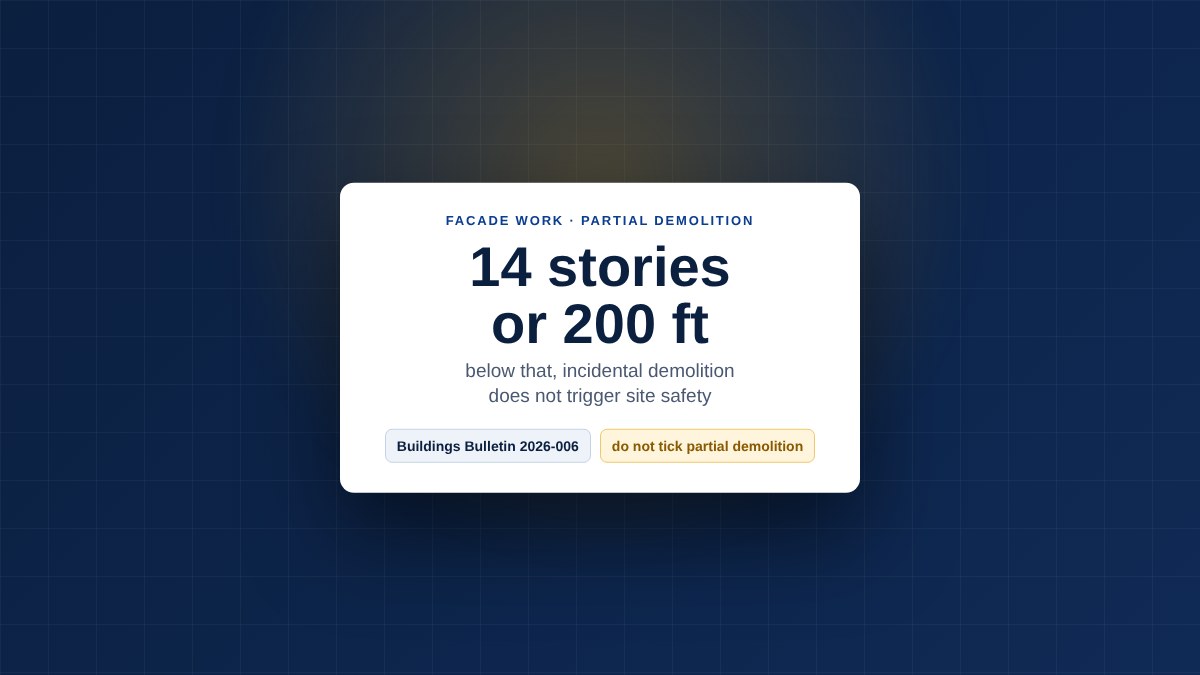
- Site safety requirements are not triggered by partial demolition that is incidental to the alteration, maintenance or repair of a facade on a building of 14 stories or 200 feet or less.
- The confusion came from a December 2024 revision that dropped the partial demolition trigger to 7 stories or 75 feet while leaving the facade trigger at more than 14 stories or 200 feet.
- Work that goes beyond incidental — removing a balcony or a fire escape, removing structural elements behind the facade, taking a facade off as part of demolishing a floor — does trigger site safety on a major building.
- Until DOB NOW is updated, the Department says do not select partial demolition in the filing, and make the notifications that BC 3306.3 requires.
In this article
For a year and a half, the same facade job was filed three different ways depending on who was asked. The Department has now put the answer in writing.
The gap, and how it happened
The document is Buildings Bulletin 2026-006, issued February 25, 2026 and signed by Deputy Commissioner Constadino Sirakis, P.E.: bb_2026-006.pdf.
Site safety requirements live in BC 3310, and their triggers in 3310.1. There are two relevant ones. The facade trigger applies to buildings over 14 stories or 200 feet. The partial demolition trigger was lowered in December 2024 to the major building threshold — seven or more stories or 75 feet or more, as Chapter 2 defines it.
Facade repair almost always involves taking something out. So the question became whether that made every facade job over seven stories a site safety job. The bulletin's answer is that the governing trigger for facade work is the facade one, and that the partial demolition trigger "shall not be read to apply to partial demolition work that is incidental to facade" work.
In practice, on facade work site safety applies when the building is more than 14 stories or 200 feet and the work requires a sidewalk shed. Both, not either.
What counts as incidental
The bulletin gives examples on both sides, which is the useful part.
Incidental, and not triggering site safety: removing stone, brick, lintels, windows, parapets or cornices in preparation for compliant replacement.
Not incidental, and triggering site safety on a major building: removing a balcony or a fire escape; removing structural elements behind the facade; removing a facade as part of demolishing a floor.
Roof work on its own does not trigger site safety. But removing roof structural members — joists, decking — is partial demolition, and counts.
The line, read across those examples, is whether the facade is being repaired or the building is being taken apart.
What is still required
Nothing here removes the safety obligations that sit elsewhere. Partial demolition that is exempt from site safety must still meet BC 3306, and the notifications under BC 3306.3 to the Department and to adjoining property owners still have to be made.
The Department also gives an operational instruction for the gap between the bulletin and the software: do not select partial demolition in DOB NOW for this work, and make the BC 3306.3 notifications outside it.
What changes in 2027
Local Law 42 of 2026 will amend section 3310.1 and takes effect in 2027. Its exceptions follow the bulletin: facade work that does not require a sidewalk shed, and facade work including incidental partial demolition on buildings not exceeding 14 stories or 200 feet.
So the bulletin is the interim reading of a rule that is about to say the same thing in its own text. Which means the practice it describes is worth adopting now rather than waiting.
The shed rules that sit beside this are in the 40-foot cap and 90-day shed permits; for work against a neighbor, shoring, underpinning and monitoring.
Frequently asked questions
Our building is 10 stories and we are replacing lintels. Site safety?
On the bulletin's reading, no. That is partial demolition incidental to facade repair on a building of 14 stories or less, which does not trigger site safety. The BC 3306 requirements and notifications still apply.
We are also taking out a fire escape. Does that change it?
Yes. Removing a fire escape is given as an example of work beyond incidental, which triggers site safety on a major building.
Does the sidewalk shed matter?
Yes. For facade work the bulletin describes site safety as applying where the building is more than 14 stories or 200 feet and the work requires a sidewalk shed.
Should we still tick partial demolition in DOB NOW?
The Department says not to, until the system is updated, and to make the BC 3306.3 notifications.
Where can I read the bulletin?
It is on the Department's buildings bulletins page, and the link is in the first section of this article.
Conclusion
This is a bulletin that removes cost rather than adding it, for the large number of mid-rise buildings doing ordinary facade repair. The distinction to hold onto is simple: replacing parts of the facade is incidental, dismantling the building behind it is not. Everything else — the notifications, the Chapter 33 protections, the shed itself — stays exactly where it was.

Written by the engineers and laboratory technicians of Metric Consulting and Inspection, a Class 1 special inspection agency with a DOB-licensed concrete testing laboratory in Hicksville, New York, serving NYC construction since 2003.