Key takeaways
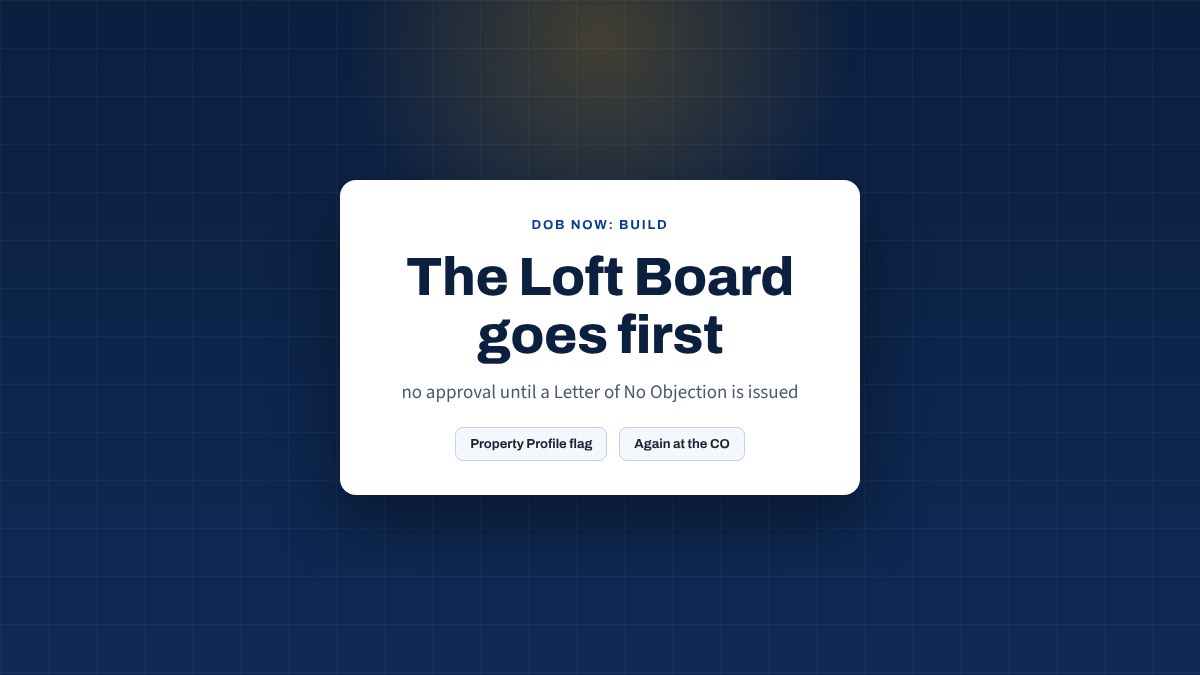
- Since February 2, 2026, Loft Board requests are submitted in DOB NOW: Build, alongside the job filing.
- A job filing on a building with a Loft Law flag in the Property Profile will not be approved until a Loft Board Request has been submitted for review and a Letter of No Objection or a Loft Board Certification has been issued.
- The Loft Board also reviews Certificate of Occupancy requests on these buildings, so the flag affects the end of the job as well as the start.
- The flag is visible on the Property Profile before you file. Checking it takes a minute; discovering it after approval stalls does not.
In this article
Most delays on a New York job come from something nobody looked up. This one is a single flag on a public page, and it puts a second agency in the approval path.
What the flag means
The Loft Law covers formerly commercial and manufacturing buildings that ended up lived in, and the New York City Loft Board is the body that administers them. Buildings within its reach carry a Loft Law flag on the DOB Property Profile.
The flag is not a violation and not a bar to work. It is a notice that a second body has a say in what happens to the building, because the units in it may be protected in ways an ordinary multiple dwelling's are not.
What changed in February
Before, Loft Board matters were handled outside the filing system. The Department announced the move in a notice dated January 8, 2026, effective February 2: Loft Board Requests in DOB NOW: Build. Since that date they sit in DOB NOW: Build with everything else, and the Department stated the consequence plainly: job filings on buildings with a Loft Law flag will not be approved until two things have happened.
| Step | What has to exist |
|---|---|
| 1 | A Loft Board Request submitted for review |
| 2 | A Letter of No Objection (LNO) or a Loft Board Certification issued |
Submitting the request is not enough. The approval waits on the outcome.
And again at the Certificate of Occupancy
The Department added one more line that is easy to skim past: the Loft Board will also review Certificate of Occupancy requests.
So the flag touches both ends of the job. A team that cleared the first gate in March and forgot about it can meet the same body again at closeout, when the schedule has no slack left.
This is the same shape as the change that made structural, foundation and earthwork permits wait on the main job: the work is unchanged, the sequence is not.
What to do
- Pull the Property Profile before you price the job. The Loft Law flag is there, in public, and it is the cheapest thing you will ever check.
- If the flag is on, put the Loft Board on the schedule as its own line — not as a note under "approvals". It has its own clock and you do not control it.
- Submit the Loft Board Request early, because approval waits on the LNO or the certification, not on the request.
- Plan the Certificate of Occupancy with the same assumption. The Loft Board reviews that request too.
- Tell the owner in writing what the flag means for the schedule. On a loft conversion the owner usually knows the building's history better than anyone on the team.
Nothing here changes the inspection scope. The special inspections your permit calls for are the same on a loft building as on any other, and they run on the construction schedule, not on the approval one. What changes is when that schedule is allowed to start.
Frequently asked questions
Where do I see the Loft Law flag?
On the building's Property Profile in the Department's system, before you file.
Does the flag mean we cannot do the work?
No. It means a second body reviews the filing, and the approval does not issue until that body has responded.
Is submitting the Loft Board Request enough to unblock the approval?
No. The Department's wording requires both the request and an issued Letter of No Objection or Loft Board Certification.
Does this affect the Certificate of Occupancy?
Yes. The Loft Board also reviews Certificate of Occupancy requests on these buildings.
Where are Loft Board requests submitted now?
In DOB NOW: Build, since February 2, 2026. They used to be handled outside the filing system.
Conclusion
A Loft Law flag is not a problem — it is a dependency, and dependencies only hurt when they are found late. Check the Property Profile at the pricing stage, put the Loft Board on the schedule as a named step with its own duration, and assume you will meet it twice: once at approval and once at the Certificate of Occupancy.
Written by the engineers and laboratory technicians of Metric Consulting and Inspection, a Class 1 special inspection agency with a DOB-licensed concrete testing laboratory in Hicksville, New York, serving NYC construction since 2003.