Key takeaways
- A compaction test compares the density of fill in the ground with the maximum density of the same soil measured in the laboratory. The result is a percentage.
- The laboratory number is the Proctor value; the field number comes from a nuclear density gauge or a sand cone. You need both.
- Fill is tested lift by lift, and a failed lift is reworked before the next one goes on. It cannot be fixed from above.
- Moisture is half the story: soil too dry or too wet will not reach density no matter how many passes the roller makes.
In this article
Placing fill looks simple: dump, spread, roll, repeat. The NYC Building Code treats it as a special inspection because a slab, a footing or a retaining wall built on fill that was not compacted will settle, crack or tilt long after the contractor has left. Compaction testing is how the inspection agency proves each lift was done right before it disappears under the next one.
What the test measures
Compaction is expressed as a percentage: the dry density of the soil in place divided by the maximum dry density that soil can reach. A specification that says 95 percent compaction means the fill in the ground must be at least 95 percent as dense as the laboratory maximum.
The maximum comes from the Proctor test, ASTM D698 (standard) or D1557 (modified), in which a sample of the actual fill material is compacted in a mold at several moisture contents. The curve shows two things the field crew needs: the maximum dry density and the optimum moisture content at which it is reached.
That means the laboratory work has to happen before the first lift. A field test against the wrong Proctor, or against no Proctor at all, is a number without meaning.
The field test
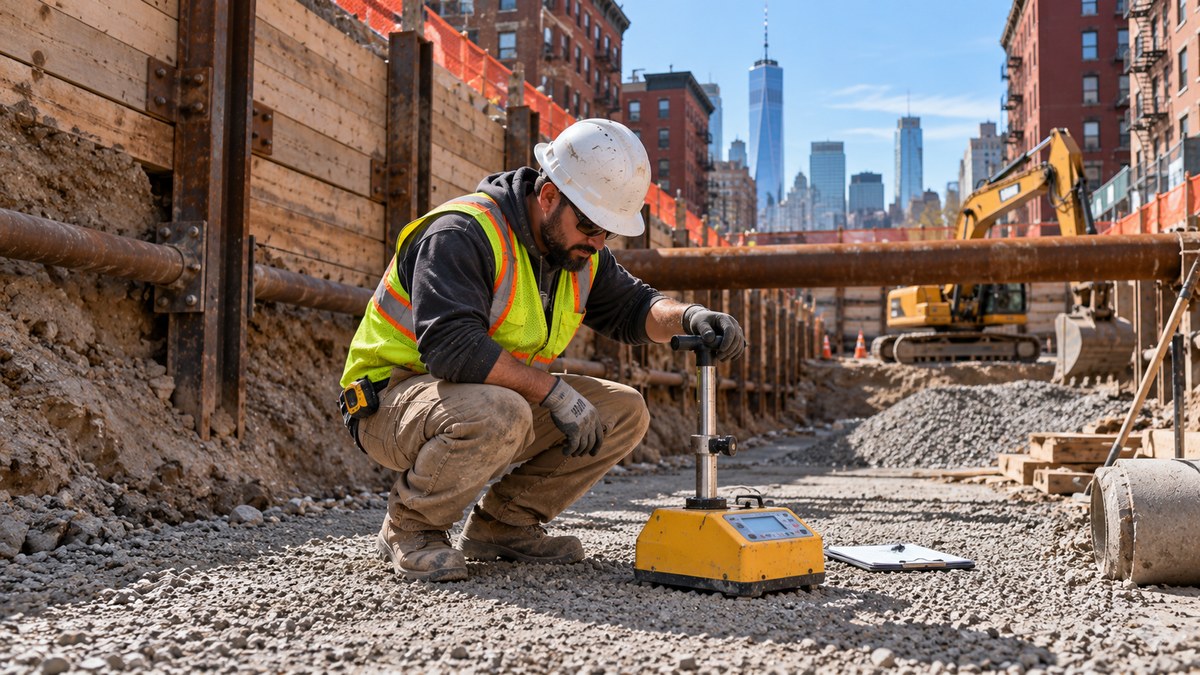
On most NYC sites the field density is measured with a nuclear density gauge, ASTM D6938. The gauge sits on the compacted surface, a probe is lowered into a small hole, and in about a minute it reads the wet density and the moisture content. From those the dry density, and therefore the percent compaction, is calculated on the spot.
Where a nuclear gauge cannot be used, the technician runs a sand cone test, ASTM D1556: a hole is dug, the removed soil is weighed and dried, and the hole's volume is measured with calibrated sand. Slower, but it needs no license and works in any material.
| Method | Time per test | Best for |
|---|---|---|
| Nuclear density gauge | About 1 to 2 minutes | Most granular and mixed fills, large areas, many tests |
| Sand cone | 30 to 60 minutes plus drying | Coarse rock fill, confined spaces, check tests |
Lifts, passes and moisture
The specification sets the maximum loose lift thickness, commonly 8 to 12 inches depending on the material and the compactor. Thicker lifts look faster but the bottom never reaches density. The inspector checks lift thickness as well as the test result.
Moisture is the variable crews most often underestimate. Soil compacts best within a narrow range around optimum, usually plus or minus 2 percent. Too dry, and the particles will not slide into a dense arrangement; too wet, and the water takes up the space the roller is trying to close. Watering or drying the fill before rolling is normal practice, not a sign something went wrong.
How many tests
The project specification and the engineer set the frequency, typically a minimum number of tests per lift per area, and at least one test per lift in small or confined areas such as utility trenches and footing backfill. The special inspection agency keeps a log that shows every lift, its elevation, the test locations and the results. That log is what the DOB looks at.
When a lift fails
A failing test is not unusual, and it is not a crisis if it is handled at once.
- The technician reports the result to the superintendent immediately, with the moisture reading.
- The crew adjusts moisture if needed and re-rolls the area.
- The technician re-tests at the same location and at least one more nearby.
- If the lift still fails, the material is reviewed: wrong Proctor, unsuitable soil, oversized rock, or frozen material.
- Only when the lift passes does the next lift go on. Each lift's result is logged with its elevation.
The one thing that cannot be done is to cover a failed lift and compact harder on top. Density does not travel downward, and the inspection agency cannot certify what it did not see pass.
The borings that precede the fill have their own qualification story: what DOB accepts now that the NICET geotechnical certification is gone. And the permit side is in why foundation and earthwork permits now wait on the main job.
Frequently asked questions
Does the fill material need to be tested before it arrives?
Yes. The Proctor test is run on the material that will actually be placed. If the source changes, a new Proctor is needed. The agency may also check gradation to confirm the material matches the specification.
Is a nuclear gauge safe on site?
Yes, when operated by a trained and licensed technician. The source is small and shielded, and the technician keeps a distance log. The gauge is stored and transported under its own license.
Can backfill around foundations be tested?
It must be. Footing and foundation backfill is one of the most common places for settlement problems, and confined areas often need smaller compactors and thinner lifts to pass.
What about controlled fill under slabs on grade?
It is treated the same way: Proctor on the material, tests on every lift, and a log tied to elevations. A slab on uncompacted fill is one of the most expensive repairs in a building.
Conclusion
Compaction testing is cheap compared to what it prevents. A Proctor test before the first lift, a gauge reading on every lift and a log that follows the elevations give the engineer, the owner and the DOB a record that the ground under the building is what the design assumed. Skip a lift and that record has a hole in it that cannot be filled later.

Written by the engineers and laboratory technicians of Metric Consulting and Inspection, a Class 1 special inspection agency with a DOB-licensed concrete testing laboratory in Hicksville, New York, serving NYC construction since 2003.