Key takeaways
- One low cylinder does not fail a pour. ACI 318 judges strength on the average of three consecutive tests and on how far any single test falls below f′c.
- When the criteria are not met, the sequence is fixed: notify, check the held cylinders, core the structure if needed, and let the engineer of record evaluate. Nobody "passes" concrete by re-breaking until a good number appears.
- Most low results trace to curing and handling, not to the mix. The 7-day result and the field data usually show which.
- Keep every report. A low test that was properly investigated and closed is a normal part of a project file; one that was ignored is a problem at closeout.
In this article
The call usually comes from the laboratory: a 28-day cylinder broke below the specified strength. The superintendent hears "failed" and sees weeks of delay. In most cases that is not what follows. The code has a precise procedure for low strength, and most low results are resolved without removing any concrete. This article walks through it in the order it happens.
First: what "failed" actually means
A strength test under ASTM C39 is the average of at least two cylinders from the same sample, broken at the same age. One cylinder is not a test. And a single test below f′c is not, by itself, a failure.
NYC Building Code §1905 adopts ACI 318, whose acceptance criteria (ACI 318-19 §26.12.3) say the strength is satisfactory when both of these hold:
- Every arithmetic average of any three consecutive strength tests equals or exceeds f′c.
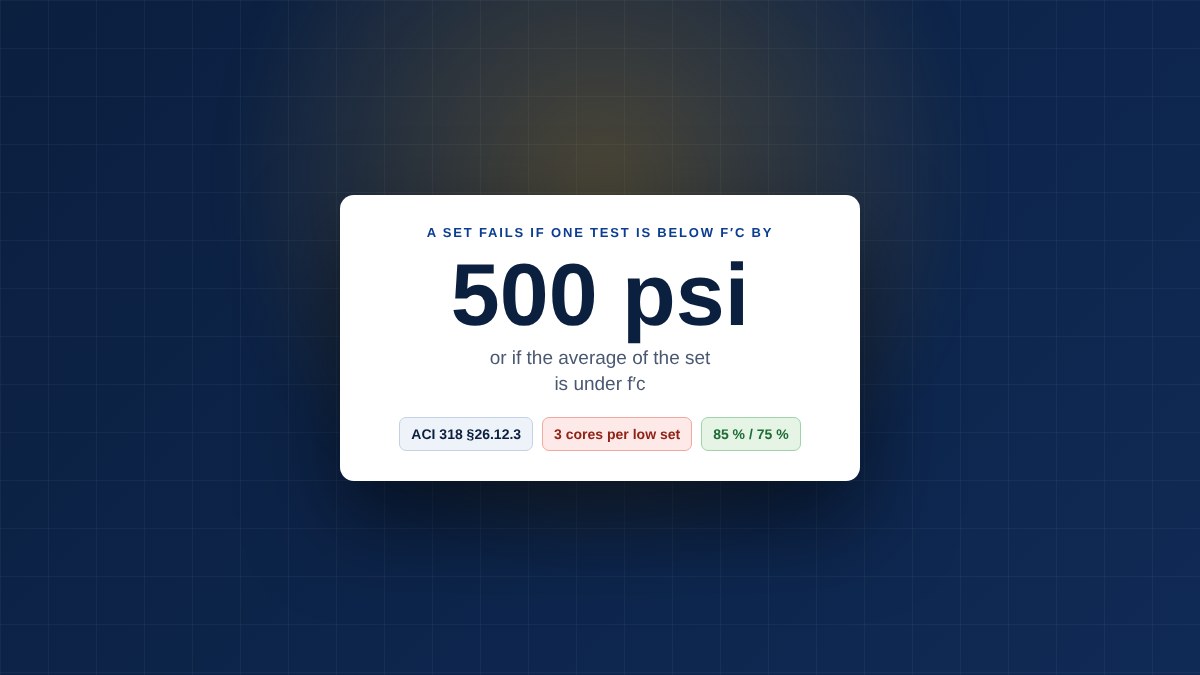
- No individual strength test falls below f′c by more than 500 psi when f′c is 5,000 psi or less, or by more than 10% of f′c when f′c is above 5,000 psi.
So on a 4,000 psi mix, a single test at 3,600 psi is acceptable if the running average of three is still 4,000 or more. A test at 3,400 psi is below the 500 psi margin and triggers the investigation whatever the average. The laboratory report should say which criterion is in question; if it just says "low", ask.
Who is told, and when
The special inspection agency reports the low result to the owner, the engineer of record, the general contractor and the concrete supplier, in writing, as soon as the break is recorded. The agency does not decide what happens to the concrete — the engineer of record does. The agency's job is to produce reliable data and to witness whatever further testing the engineer orders.
On Metric's projects a nonconformity is reported within 24 hours and goes in the project's nonconformity log, with the date, who was notified and how it was closed. That log is what the DOB may ask to see.
Step one: look at the data you already have
Before anyone drills a core, the engineer and the agency look at the file:
- The 7-day result for the same set. If the 7-day was normal (60–75% of f′c) and the 28-day is far below, something happened to the cylinders between 7 and 28 days, not to the structure.
- The held cylinder. Most sets include a spare. Breaking it at 28 days (or at 56) gives a third data point.
- Field data from the pour: slump, air content, concrete temperature, time from batching to placement, truck ticket, water added on site.
- Curing records: where the cylinders sat for the first 48 hours, at what temperature; whether the structure itself was protected (cold weather, hot weather).
- The break itself: fracture type, cylinder ends, whether the specimen was capped or padded correctly.
A large share of low 28-day results are explained here: cylinders left in the sun or frozen on site, a mix with slow-gaining cementitious material broken too early, or water added at the truck. In those cases the engineer may accept the concrete on the basis of the held cylinder and the field data, or wait for a 56-day break.
Step two: cores
If the data do not resolve it and the second criterion was missed (a test more than 500 psi below f′c), ACI 318 §26.12.6 requires cores from the questionable area: three cores per strength test that fell below the limit, taken under ASTM C42 from locations the engineer selects, avoiding reinforcement.
The acceptance rule for cores is more lenient than for cylinders, because cores are cut from the real structure: the concrete is considered structurally adequate when the average of the three cores is at least 85% of f′c and no single core is below 75% of f′c. Cores are conditioned (kept in sealed bags at lab temperature) for at least five days before testing, so results take about a week from drilling.
Cores are drilled by the laboratory or a coring contractor, witnessed and logged by the agency, and the holes are patched. On a slab the work takes a few hours; on a column it takes planning.
Step three: the engineer's evaluation
If the cores also fall short, or if coring is impractical, the engineer of record evaluates the structure. The options, in rough order of frequency:
- Accept as is, on the basis that the member has reserve capacity or the low strength is in a non-critical location — documented in a letter to the file.
- Load test the member under ACI 318 Chapter 27, witnessed by the agency.
- Strengthen the element (additional reinforcement, jacketing, supplementary supports).
- Remove and replace — the last resort, and rare.
Whatever is decided, the engineer's letter, the test reports and the agency's logs together close the nonconformity. That package is what makes the final TR1 signable.
What it costs in time
| Stage | Typical duration |
|---|---|
| Low result reported | Day 28 |
| Held cylinder broken, data reviewed | 1–3 days |
| Cores drilled | within 1 week of the decision |
| Cores conditioned and tested | 5–7 days after drilling |
| Engineer's evaluation | 1–2 weeks after core results |
A straightforward case resolved on the file costs a few days. A case that goes to cores costs about three weeks. The work above the questionable pour usually continues in the meantime, at the engineer's discretion.
How to make it rare
- Cure cylinders properly on site: 60–80 °F, protected from sun, wind and freezing, for the first 24–48 hours. A cure box is cheap.
- Do not add water at the truck beyond the mix design's allowance; the technician records it.
- Keep the 7-day results in view. A trend of low 7-day breaks is a mix problem to fix before the 28-day results arrive.
- Protect the concrete itself in cold weather (see our article on cold weather requirements).
Before the 28-day result there is an earlier signal, explained in 7-day versus 28-day strength; and the numbers themselves are easier to read with our guide to a concrete test report.
Frequently asked questions
Can we just break the spare cylinder and use that result?
The spare is part of the evidence, not a substitute for the test. Its result is reported alongside the original and the engineer weighs both. Nobody discards the low result.
Does a failed test have to be reported to the DOB?
The result goes in the agency's records and nonconformity log, which the DOB can audit. The final TR1 certifies that the work complies; a low test that was investigated and closed by the engineer complies. A low test that was ignored does not.
Who pays for the cores?
Usually the contractor, under most contracts, if the low result traces to placement or curing; the supplier, if it traces to the mix. The engineer's findings decide. The core testing itself is a laboratory line item.
Can the agency's lab be the problem?
It can, which is why the laboratory must be DOB-licensed and accredited, with calibrated machines and documented procedures. If the data point to the lab (for example, cylinders capped badly), the agency says so and retests.
Conclusion
A low cylinder is a data point, not a verdict. The code gives a fixed sequence — check the file, break the held cylinder, core if needed, let the engineer decide — and most cases close in days without touching the structure. What turns a low break into a real problem is not the number; it is a missing 7-day result, no curing record, or nobody notified. Keep the file complete and the procedure does the rest.

Written by the engineers and laboratory technicians of Metric Consulting and Inspection, a Class 1 special inspection agency with a DOB-licensed concrete testing laboratory in Hicksville, New York, serving NYC construction since 2003.