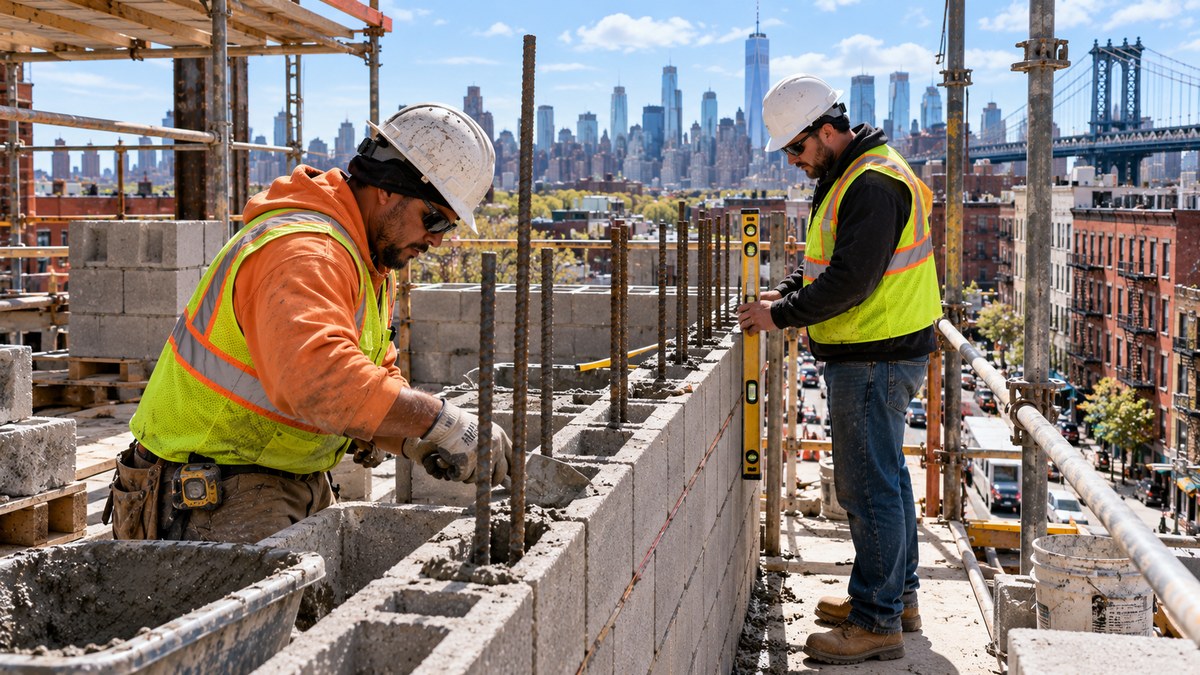
Key takeaways
- Masonry special inspection covers the materials (mortar, grout, units) and the construction (reinforcement, grout spaces, joints, protection) of structural masonry.
- The inspector verifies that what is being built matches the drawings before the grout hides it.
- Mortar and grout are sampled and tested in the laboratory; prisms prove the assembled strength when the design requires it.
- Cold-weather and hot-weather procedures are part of the inspection, not an afterthought.
In this article
Masonry is one of the oldest ways to build in New York, and one of the hardest to check after the fact. Once the grout is in the cells and the wall is capped, the reinforcement, the grout spaces and the quality of the bed joints are invisible. That is why Chapter 17 of the NYC Building Code lists masonry construction as a special inspection: the agency has to see it while it can still be seen.
What is inspected
Masonry special inspection applies to structural masonry: load-bearing walls, shear walls, lintels, piers and columns of concrete block, brick or stone that the engineer relies on in the design. Veneer that carries only its own weight is typically covered by other, lighter requirements, but the engineer's drawings and the TR1 say what applies to your project.
The inspection follows the quality assurance level the engineer assigned under the masonry standard (TMS 402 and TMS 602). A higher level means more frequent visits and more testing. The inspector's checklist is the same in substance for all of them.
| Area | What the inspector verifies |
|---|---|
| Materials | Units, mortar type, grout mix and reinforcing steel match the specification; certifications are on file |
| Reinforcement | Bar size, spacing, lap lengths, placement within the cell, clearance from the unit face |
| Grout spaces | Cells and collar joints are clean, cleanouts are provided where required, mortar fins are removed |
| Grouting | Lift height, consolidation, reconsolidation, timing relative to mortar set |
| Joints | Bed and head joints are full, tooled and of the right thickness |
| Anchorage | Ties, anchors and connectors to the structure are the right type and spacing |
| Weather | Protection and procedures for cold weather and hot weather are followed |
The sequence on site
Masonry inspection works best when the agency is part of the schedule, not called after the fact.
- Before the first course: the inspector reviews the approved drawings and specifications and confirms the materials on site match them.
- During laying: periodic checks of mortar joints, unit placement and bond pattern; continuous observation where the quality assurance level requires it.
- Before grouting: verification of reinforcement and grout spaces in every lift about to be grouted. This is the step that cannot be repeated once the grout is in.
- During grouting: lift height, consolidation and sampling of the grout.
- Throughout: sampling of mortar and grout for laboratory testing, and prisms when the design requires them.
Mortar, grout and prisms
Three laboratory tests back up the field inspection.
Mortar
Mortar is sampled in the field under ASTM C780 and tested for compressive strength and, where specified, air content and water retention. The purpose is consistency: the mortar used on Tuesday should be the same as the mortar on Monday.
Grout
Grout is sampled under ASTM C1019 into molds formed with masonry units, so the sample loses water the same way the grout in the wall does. The specimens are cured and broken for compressive strength, typically at 28 days.
Prisms
When the design strength of the masonry is verified by the prism method, the mason builds small assemblies of units, mortar and grout under ASTM C1314. They are cured and tested in compression. The result is the strength of the wall as built, not of its parts separately.
Weather
New York gives masons both extremes. In cold weather the inspector checks that units are not frozen, that mortar and grout are kept above the minimum temperature, and that the finished work is protected for the required period. In hot weather the concern is the opposite: mortar drying out before the next course, and grout losing water to hot units. The procedures are part of the specification and the inspector records that they were followed.
Most masonry repair happens behind a shed, which now has rules of its own: see the 40-foot cap and when site safety is not triggered below 14 stories.
Frequently asked questions
Is brick veneer on a wood-frame house a special inspection?
Usually not. Veneer that is only attached to the backup and carries no load from the structure is generally outside the structural masonry requirements. The engineer's drawings decide.
What happens if reinforcement is missing when the inspector arrives before grouting?
The inspector reports it, the mason corrects it, and grouting waits for the re-check. That is exactly what the pre-grout inspection is for. Grouting without the check is the problem, not the correction.
Who provides the prism samples?
The mason builds them on site under the inspector's observation, using the same materials and workmanship as the wall. The agency cures and tests them.
How often does the inspector need to be on site?
It depends on the quality assurance level in the design and on the schedule. For most structural block walls, the pre-grout checks are the fixed points; the rest is agreed with the mason week by week.
Conclusion
Masonry inspection is about timing. The materials can be tested at any point, but the reinforcement and the grout spaces can only be verified in the hours before the grout goes in. Put the agency in the schedule, make the pre-grout check a fixed step, and the final certification on the TR1 will reflect a wall that was built the way it was designed.

Written by the engineers and laboratory technicians of Metric Consulting and Inspection, a Class 1 special inspection agency with a DOB-licensed concrete testing laboratory in Hicksville, New York, serving NYC construction since 2003.