Key takeaways
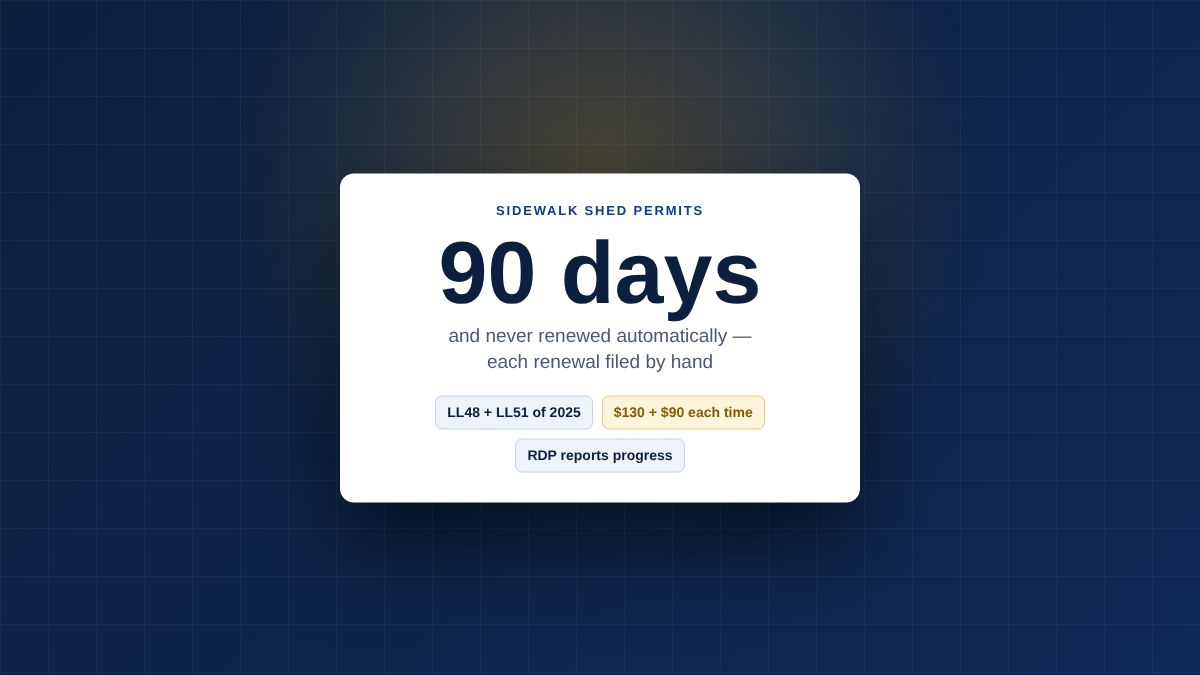
- Sidewalk shed permits in DOB NOW now run for a maximum of 90 days and, in the Department's words, "will not be automatically renewed." Every renewal is a manual filing.
- Each renewal carries a renewal fee, and since August 17, 2026 most sheds also carry a progress report fee, charged by the Department on every renewal.
- On a covered shed, the registered design professional is added to the PW2 as a stakeholder and must log in to DOB NOW to answer questions about the progress of the work at each permit request and each renewal.
- A shed installed as part of new building, enlargement or demolition work that already holds a permit is outside these requirements, as are one- and two-family homes.
In this article
A sidewalk shed used to be the easy part of a façade job: put it up, renew the permit without thinking, take it down whenever the work finished. Under two laws passed in 2025, it has become the part of the job that comes back every quarter asking what you have been doing.
The rules are not complicated, but they are easy to be caught by — because nothing arrives to remind you. A permit simply stops.
What changed
The Department set out the first half in a service notice issued on January 8, 2026, covering the filing and permit changes under Local Law 48 and Local Law 51 of 2025: Sidewalk Shed Filing and Permit Changes in DOB NOW. The second half came in a follow-up notice on August 7, 2026, which added the progress report and its fee: Sidewalk Shed Progress Report and Progress Report Fee. The fees are set under 1 RCNY §101-03 and §102-07.
Three things changed at once.
Permits expire every 90 days. The maximum duration of a sidewalk shed permit is ninety days from the date of issuance, and each one "must be manually renewed" at the end of that period. Permits issued before February 2, 2026 expire as they would have under the old rules; everything issued or renewed since runs on the new clock.
Renewal is never automatic. This is the sentence that costs people money. There is no rollover and no grace: when the ninety days are up, the permit is expired, and a shed standing over a public sidewalk without a permit is an enforcement problem, not a paperwork one.
The design professional has to speak. On a covered shed, the registered design professional is added to the PW2 as a stakeholder and must log in to DOB NOW and answer new questions about the progress of the work — at the initial permit request and again at every renewal. Since August 17, 2026 those answers must give specific details about how the work is advancing.
Who is exempt
Not every shed is covered, and the distinction is made by a question on the PW1: is the shed being installed in connection with new building, enlargement or demolition work that already has a permit?
If the answer is yes, the Department states that "the requirements of Local Law 48 and Local Law 51 do not apply to the sidewalk shed," and no work-progress questions appear on the PW1 or the PW2. A shed around a tower under construction is simply part of that job.
If the answer is no — the shed is up because the façade needs repair, or because a condition was found and nothing has been scheduled yet — the new requirements apply in full. That is deliberate. These rules are aimed at the shed that goes up and then stands for years while nothing happens behind it.
One- and two-family homes are outside the progress report requirement.
What a renewal costs
Under the Department's fee rules, each renewal of a sidewalk shed permit carries a renewal fee of $130. On a covered shed, the progress report adds another $90 to every renewal, per the Department's August 2026 notice. That is $220 charged by the Department every ninety days, roughly four times a year, for as long as the shed stands.
For a single shed on a single building, the money is not the point. For an owner with a dozen buildings in façade cycles, or a contractor carrying sheds on several jobs, the arithmetic changes — and so does the administrative load, because each renewal needs the design professional to log in and answer.
How to not get caught
- Put every shed permit's expiry date in one calendar, with a reminder three weeks out. Nothing will remind you — the permit just ends.
- Tell your design professional now that they are a stakeholder on each covered shed and will have to answer progress questions every ninety days. Make sure the person who actually knows the job is the one logged in.
- Have an honest answer ready about progress. The question exists because the city wants sheds to come down. A renewal that reports no movement, quarter after quarter, is a record someone can read later.
- Budget the renewals on long jobs, and decide who pays them — the owner or the contractor — before the first one arrives.
- Plan the removal as a dated task in the schedule, not as something that happens when the work happens to finish.
Two other changes come from the same law: the 40-foot cap on shed coverage and the proposed standard shed designs.
Frequently asked questions
Does the 90-day clock apply to a shed I put up last year?
Permits issued before February 2, 2026 expire as they would have under the prior rules. Anything issued or renewed since then runs for ninety days.
Who answers the progress questions, the contractor or the design professional?
The registered design professional, who is added to the PW2 as a stakeholder and must log in to DOB NOW to answer. The contractor supplies the facts, but the filing is the professional's.
My shed is up for a new building that already has a permit. Am I covered?
No. Where the shed is installed in connection with new building, enlargement or demolition work with an issued permit, the Department states that Local Law 48 and Local Law 51 do not apply to the shed.
What happens if the permit lapses?
The shed is then standing over a public sidewalk without a permit. Renew before the ninety days are up rather than finding out what the Department does about it.
Where can I read the notices myself?
Both are on the Department's service updates page, and the links are in the second section of this article.
Conclusion
The city has made a shed expensive to ignore and cheap to take down. Ninety days is short enough that no one forgets they have one, and the progress question makes a standing shed into a statement about the owner, recorded four times a year. If you carry sheds, the whole of the compliance job is a calendar entry, a conversation with your design professional, and a line in the budget — set up once, at the start.

Written by the engineers and laboratory technicians of Metric Consulting and Inspection, a Class 1 special inspection agency with a DOB-licensed concrete testing laboratory in Hicksville, New York, serving NYC construction since 2003.