Key takeaways
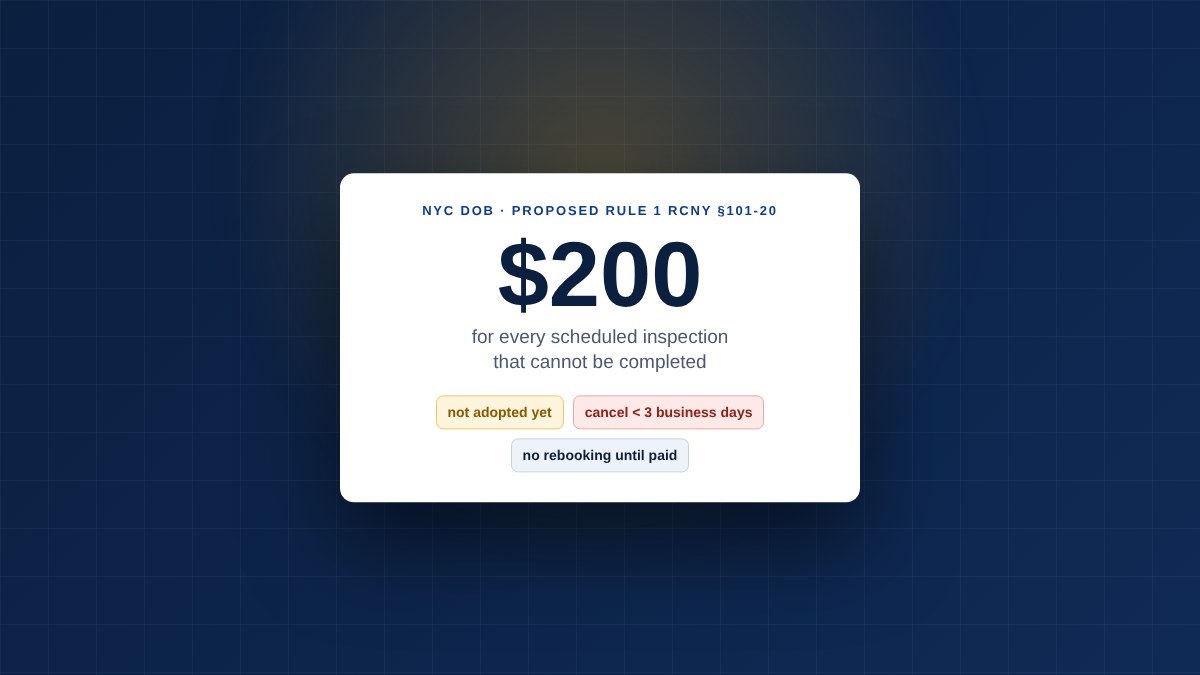
- The Department of Buildings has proposed a new rule, 1 RCNY §101-20, charging the permit holder $200 for each scheduled electrical, plumbing or construction inspection that ends up incomplete.
- The definition is broad: nobody there, site not prepared, the person on site unfamiliar with the scope of work, no full access, missing documentation — or a cancellation received fewer than three business days before the appointment.
- You cannot reschedule the inspection until the fee is paid. Repeated incomplete inspections, or an unpaid fee within one calendar year, can be referred for suspension, revocation or denial of a license renewal.
- The rule is still proposed. The hearing was held on September 9, 2026 and the comment period has closed, but the rule has not been adopted and no effective date has been set.
In this article
An inspector drives to your job, and the work is not ready. The riser is behind a locked door, the superintendent with the key is at another site, or the person who meets the inspector cannot say what was installed. Today that costs you a slot in the schedule. Under a rule the Department of Buildings has proposed, it would also cost $200 — and you would not be able to book the next appointment until you paid it.
Here is what the proposed rule actually says, who it reaches, and what it would take to never see the charge.
What the Department has proposed
The rule would add a new section, 1 RCNY §101-20, to Title 1 of the Rules of the City of New York, under the authority of sections 643 and 1043(a) of the City Charter and section 28-116.3 of the Administrative Code.
The operative sentence is short. The Department would charge the permit holder a fee of two hundred dollars for each inspection scheduled by that permit holder that results in an incomplete inspection.
It applies, in the Department's own words, to registered design professionals, licensees, general contractors, third-party contractors, owners and filing representatives who request an inspection of an electrical, plumbing or construction installation.
What counts as incomplete
The definition is the part worth reading twice. An incomplete inspection is a scheduled inspection that must be rescheduled because the permit holder or licensee:
- fails to appear;
- fails to prepare the site;
- is unfamiliar with the scope of work;
- fails to provide full access, documentation, or the conditions necessary for the Department to conduct the inspection.
The rule then lists specific circumstances — introduced as "not limited to", so the list is open — including failure to keep an appointment, an inspection declined on arrival, and a cancellation request received fewer than three business days before the scheduled appointment.
That last one is the trap. A pour that slips, a delivery that does not arrive, weather on Thursday for a Friday inspection: in construction, the decision to cancel is often made the day before. Under this rule, the day before is already late.
Note also what the definition does not require: bad faith. "Unfamiliar with the scope of work" is enough. If the person who meets the inspector is whoever happened to be free that morning, the visit can end as an incomplete inspection.
Who gets the bill
The fee follows the permit holder — the party who scheduled the inspection — not whoever actually caused the delay. On a typical job that means the licensed electrician, plumber or the general contractor, even when the reason the inspector could not get in was a subcontractor, a tenant, or a locked gate that belongs to someone else.
That makes it a contract question as much as a code question. If your subcontracts do not say who carries a charge like this, the party holding the permit carries it. Agencies and trades that already pass through show-up and cancellation fees will recognize the shape of the problem.
The rescheduling bar, and what happens if it repeats
Two provisions give the fee its teeth.
You cannot reschedule until you pay. Under §101-20(d), the permit holder may not reschedule an incomplete inspection until the fee has been paid to the Department. The $200 is not an invoice that arrives later; it sits between you and the next appointment.
It can reach the license. Under §101-20(e), the Department may, in its sole discretion, refer a licensee or registered design professional who has incurred repeated incomplete inspections — or who has failed to pay a fee within one calendar year — for further enforcement, which can include suspension, revocation or denial of a renewal.
Challenging a fee
A fee can be challenged within 30 days of being imposed, under §101-20(f). The challenge is filed electronically through the Department's website, with supporting documentation, and the Department decides — in its sole discretion — whether to dismiss or uphold the fee, then issues a notice of determination.
Thirty days is short, and the burden sits with you. If an inspection is recorded as incomplete and you believe it was not, the time to collect the evidence is that week: the site log, the photographs, the message trail showing the inspector was given access or that the cancellation was sent in time.
Is this about special inspections?
No, and the distinction matters.
This fee is for the Department's own inspections of electrical, plumbing and construction installations — the visits you request from DOB. Special inspections under Chapter 17 are performed by a private agency the owner engages, and the agency's own cancellation and show-up terms are a matter of your contract with it, not of this rule.
What the two have in common is the discipline. A job that knows which inspections it needs, who calls them, how much notice each one takes and who meets the inspector at the gate does not generate incomplete inspections of either kind. A job that improvises generates both. If you want the full list for the special inspection side, our TR1 checklist for general contractors sets out what to send, when to call and what closeout needs, and the TR1 itself is explained here.
What to do before the rule lands
None of this is expensive to prevent. Four habits cover almost every case:
- Name one person per inspection who knows the scope and will be at the gate — not whoever is free. Give the inspector that name and number when you book.
- Walk the work the day before, not the morning of: access, keys, ladders, power, and the documents the inspector will ask for.
- Cancel early. Treat three business days as the deadline it would become. If Friday looks doubtful on Tuesday, say so on Tuesday.
- Write it into the subcontracts. Decide now who carries a charge caused by a trade that was not ready, so it is not a conversation after the first one arrives.
Where the rule stands
As of today the rule is proposed, not adopted. The public hearing was held on September 9, 2026, the comment period has closed, and the Department received comments from trade groups, a chamber of commerce and individual professionals. No effective date has been set.
That means two things. There is still nothing to pay. And the final text can change — the comments argued, among other things, about the three-day cancellation window and about the Department deciding challenges at its own discretion. We will publish an update here when the rule is adopted or withdrawn.
Frequently asked questions
Is the $200 fee in effect now?
No. The rule is proposed. It was heard on September 9, 2026 and comments are closed, but it has not been adopted and no effective date has been published.
Does it apply to special inspections by a private agency?
No. It covers inspections performed by the Department of Buildings on electrical, plumbing and construction installations. Special inspections under Chapter 17 are performed by the registered agency the owner engages, under that agency's contract terms.
What if the subcontractor is the reason the inspector could not work?
The fee follows the permit holder who scheduled the inspection. Recovering it from the responsible trade is a matter for your subcontract, which is the argument for writing that line now.
How long do I have to challenge a fee?
Thirty days from the imposition of the fee, filed electronically with supporting documentation. The Department decides at its sole discretion and issues a notice of determination.
Where can I read the rule myself?
The proposed rule, the Department's statement of basis and purpose, and the public comments are on the City's rulemaking portal at rules.cityofnewyork.us.
Conclusion
The proposal turns a wasted trip into a priced event, and prices it twice: $200, and the time until you can rebook. The defense is unglamorous and free — one named person who knows the work, a walk-through the day before, and cancellations sent while they are still early. Jobs that already run that way will never see the fee. Jobs that improvise will see it often, and the second one is the expensive one, because that is where a pattern starts.

Written by the engineers and laboratory technicians of Metric Consulting and Inspection, a Class 1 special inspection agency with a DOB-licensed concrete testing laboratory in Hicksville, New York, serving NYC construction since 2003.