Key takeaways
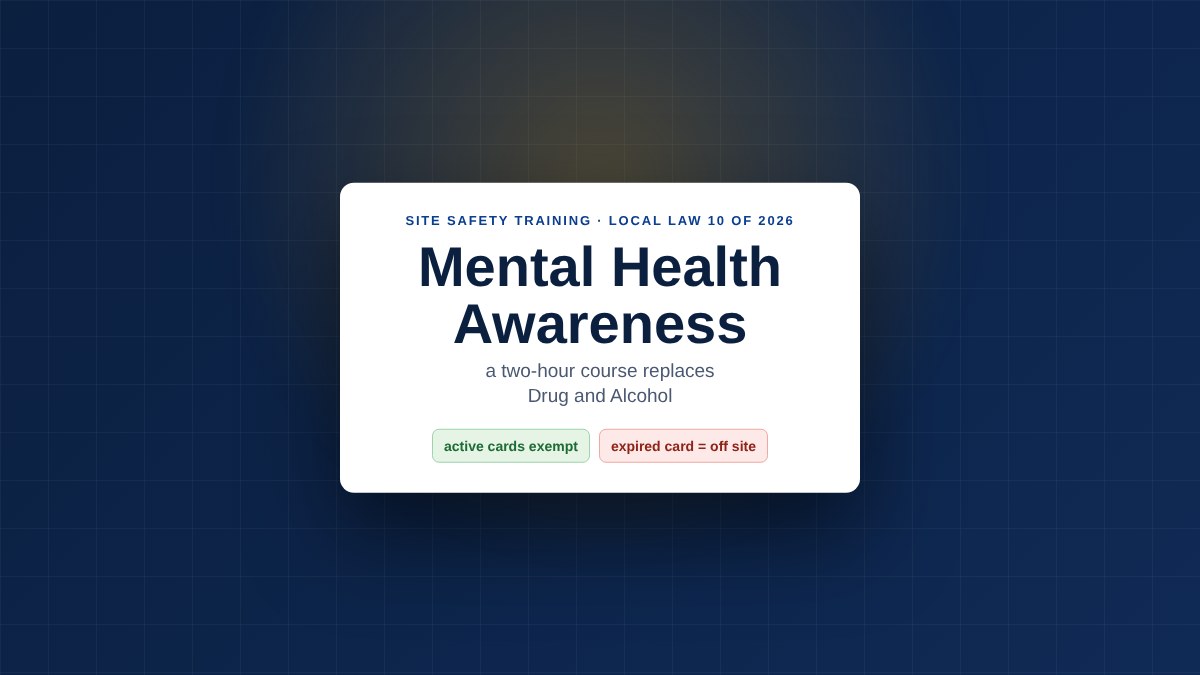
- Local Law 10 of 2026 took effect on May 3, 2026 and added mental health and wellness, suicide risk and prevention, and alcohol and substance misuse to the Site Safety Training program.
- A two-hour Mental Health Awareness course replaced the two-hour Drug and Alcohol Awareness course. Since August 1, 2026 the old course is no longer offered and only the new one counts toward a new card.
- Workers who already hold an active SST card do not have to take the new course.
- Cards expiring on or after May 3, 2026 can be renewed within one year after expiry — but during that window the expired card cannot be used on a jobsite. Miss the year and the worker starts over with a new card application.
In this article
Site safety training is the kind of compliance that lives in a folder until the day a card expires and a worker is sent home from the gate. Local Law 10 of 2026 changed what is in the training and, more importantly for a contractor, what happens when a card runs out.
What the law added
The Department set it out in a service notice dated April 23, 2026: Local Law 10 of 2026 Updates Site Safety Training Program. In its words, "Effective May 3, 2026, Local Law 10 (LL10) of 2026 updates the Site Safety Training (SST) Program."
The new content is about the people on the site rather than the site itself: mental health and wellness, suicide risk and prevention, and alcohol and substance misuse on construction sites.
It arrives as a two-hour Mental Health Awareness course, which replaces the two-hour Drug and Alcohol Awareness course that was there before. The hours did not go up; the subject widened.
Course providers were given ninety days to build the new course, and during that period either one could be offered. That transition is over: since August 1, 2026 the Drug and Alcohol course is no longer offered, and only the Mental Health Awareness course counts toward the issuance of a new SST card.
One more change went in at the same time. For the issuance of a new SST card, the Department states that "the 40-Hour Site Safety course is equivalent to the 30-Hour OSHA course," as of May 3, 2026.
Who has to do anything
Most of your workforce does not. A worker holding an active SST card is not required to take the Mental Health Awareness course. The new requirement reaches the people getting a card for the first time.
So the practical exposure is at the edges of the crew: new hires, workers coming back after a gap, and anyone whose card has lapsed.
The renewal window, and the trap inside it
This is the part worth reading twice.
A card that expires on or after May 3, 2026 can be renewed within one year of its expiry date. That sounds generous, and it is — but the Department attaches a sentence to it: "During the grace period, expired cards cannot be used on a jobsite."
In other words, the year is time to fix the paperwork, not permission to keep working. A worker whose card expired last month is off the site today, grace period or not.
And if the year passes without a renewal, the worker does not renew at all — failure to renew "will require the worker to apply for a new SST card issuance." That is a longer, more expensive road than a renewal.
What a contractor should do about it
- Pull the expiry date of every SST card on your crews into one list, with the worker's name. Most contractors keep the cards; few keep the dates.
- Flag everything expiring in the next six months. Those are the renewals to book now, because a lapsed card means a worker who cannot be on site tomorrow morning.
- Check anyone who has been away — long leave, a spell with another trade, a return after a layoff. Lapsed cards hide in that group.
- Tell new hires what they need before the first day, now that the Mental Health Awareness course is the only version on offer.
- Keep a copy of the renewal receipt, not just the card. When a card is in the renewal window, the paperwork is what shows the worker is in process.
The other site safety change of the year is the one-job limit on construction superintendents, and on facade jobs it is worth knowing when site safety is not triggered at all.
Frequently asked questions
Do my current workers have to retake training?
No. The Department states that holders of active SST cards are not required to take the Mental Health Awareness course. The requirement applies to the issuance of new cards.
Can a worker stay on site while the card is being renewed?
No. The one-year window is for renewing, and the Department says expired cards cannot be used on a jobsite during it.
What if the year passes and the card was never renewed?
The worker must apply for a new SST card rather than renewing the old one, which takes longer.
Is the Drug and Alcohol course still accepted?
It has not been offered since August 1, 2026, and only the Mental Health Awareness course counts toward a new card.
Where can I read the notice?
It is on the Department's service updates page, and the link is in the first section of this article.
Conclusion
The training content changed quietly; the renewal rule is what will cost someone a day. A one-year window reads like breathing space until you notice the worker cannot be on the site during it. Keep the expiry dates in one list, look at it monthly, and nobody gets turned away at the gate.

Written by the engineers and laboratory technicians of Metric Consulting and Inspection, a Class 1 special inspection agency with a DOB-licensed concrete testing laboratory in Hicksville, New York, serving NYC construction since 2003.