Key takeaways
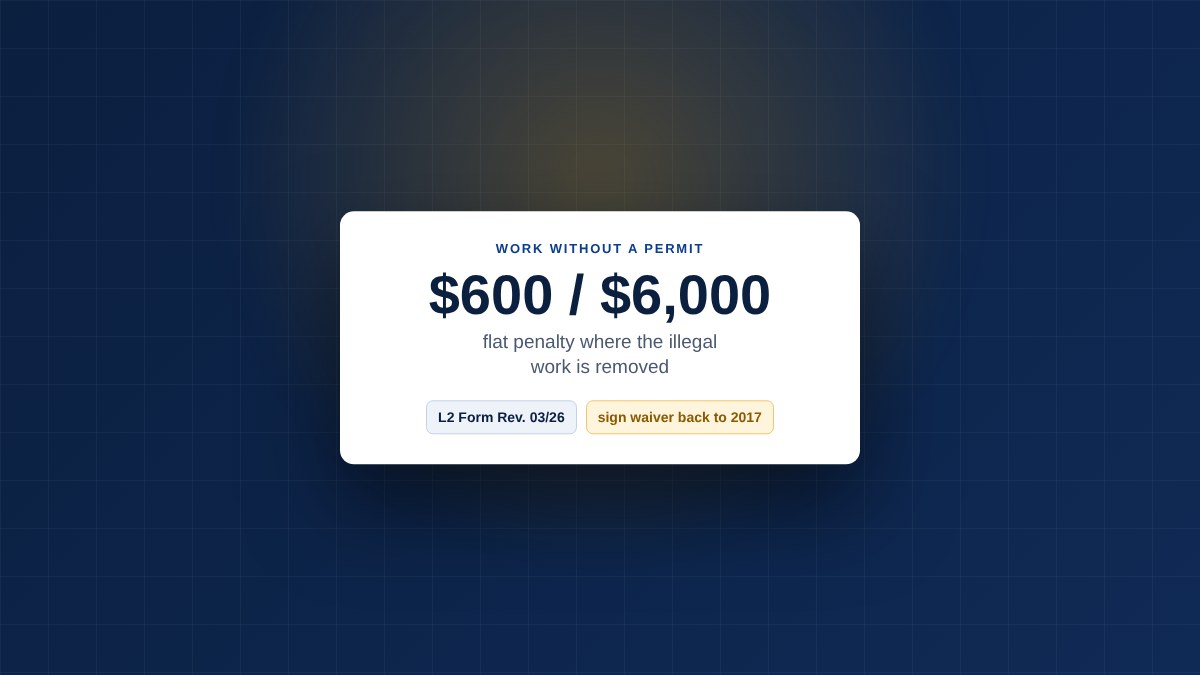
- Since March 30, 2026, the Department accepts only the L2 Form, revision 03/26, for a request to override, reduce or waive a civil penalty for work without a permit. The matching instructions carry the same revision date.
- The revised form adds an Accessory Sign Penalty Waiver: penalties imposed on or after December 28, 2017 on a business storefront sign may be waived, within size limits.
- It also adds Removal of Illegal Work, where taking the unpermitted work out reduces the penalty to a flat amount set by the Department.
- The changes come from Local Law 15 of 2026, with the penalty provision at §28-213.1 and the procedure in 1 RCNY §102-04.
In this article
A civil penalty for work without a permit is one of the few numbers in New York construction that can be argued down, and most people do not know the form exists. It does, it was rewritten this year, and the old version is no longer accepted.
What changed
The Department announced it in a notice dated March 25, 2026, effective March 30: Work Without a Permit: Requesting an Override, Reduction, or Waiver of Civil Penalties.
From that date, in the Department's words, "only the updated L2 Form with the revised date of Rev. 03/26" is accepted for review. The instructions were revised at the same time and carry the same date in the lower right corner — worth checking, because an old instruction sheet usually travels with an old form.
The legal basis is Local Law 15 of 2026, the penalty itself sits at §28-213.1 of the Administrative Code, and the procedure is in 1 RCNY §102-04.
The two new routes
Accessory Sign Penalty Waiver. Penalties on a business storefront sign may be waived, and the reach is backwards: the Department states that "outstanding penalties imposed on or after December 28, 2017, will be waived." The sign has to stay within limits — not more than 150 square feet and not more than 1,200 pounds — and the waiver does not apply where the sign "creates imminent threat to public safety or health."
For a small business carrying an old sign violation, that is the most useful sentence the Department has published this year.
Removal of Illegal Work. Where the unpermitted work is removed, the penalty becomes a flat amount rather than a calculated one. The Department sets it at $600 for work performed on a one- or two-family dwelling and $6,000 for other buildings. The notice adds a detail that matters on small jobs: this applies even where the removal itself did not require a permit.
Why the second route is the interesting one
A penalty for work without a permit is normally calculated, and on a job of any size the calculation runs well past the flat figures above. Removal turns an open-ended number into a known one.
That changes the arithmetic of a decision that owners usually make emotionally. The question stops being "how do we keep what we built" and becomes a comparison: the cost of taking the work out plus the Department's flat penalty, against legalizing it plus the calculated penalty — and legalizing is not always available.
It is not a route for every case. Work that is sound, compliant and worth keeping should be legalized. But where the work was going to come out anyway, doing it before the penalty is settled is worth the conversation with your expediter or attorney.
Practical notes
- Download the form fresh. Check for Rev. 03/26 on both the form and the instructions. A copy saved on someone's desktop last year will be rejected.
- Read the sign waiver against your own storefronts if you manage retail property. Penalties going back to December 2017 are in scope.
- Price the removal option before deciding to fight the penalty, especially on a one- or two-family dwelling where the Department's flat figure is small.
- Do not assume a waiver is automatic. The Department decides the request; the form is an application, not a notification.
- Keep the violation and the request together in one file with dates, because the schedule of a penalty request is as important as its content.
Other costs moved this year too: the new DOB NOW fees for parking structure and facade filings and the proposed fee for an incomplete inspection.
Frequently asked questions
Which form version is accepted now?
Only the L2 Form with revision date Rev. 03/26, together with the Rev. 03/26 instructions. The revision date is in the lower right corner of each.
Does the sign waiver cover any sign?
It covers accessory business storefront signs within the stated limits of 150 square feet and 1,200 pounds, and not where the sign creates an imminent threat to public safety or health.
If I remove the work, is the penalty automatically reduced?
The reduced flat penalty is the route the form provides for removal of illegal work. It is still a request that the Department reviews, so document the removal.
Does it matter that the removal itself needed no permit?
No. The notice says the reduction applies even where the removal did not require a permit.
Where can I read the notice?
It is on the Department's service updates page, and the link is in the first section of this article.
Conclusion
Most violations get paid because nobody reads the route out. The revised L2 form adds two of them, one aimed at storefront signs carrying years of penalties, and one that turns an open-ended penalty into a flat figure for anyone willing to take the work back out. Neither is automatic, both are applications, and both start with downloading the current version of a form.

Written by the engineers and laboratory technicians of Metric Consulting and Inspection, a Class 1 special inspection agency with a DOB-licensed concrete testing laboratory in Hicksville, New York, serving NYC construction since 2003.